


The Necessary Discomfort: Why Actors Must Push Boundaries, Step Into Danger, and Embrace the Roles We Do Not Agree With
by Sarafina Vecchio
There is a moment- electric, unsettling, almost nauseating- when an actor feels themselves cross a threshold. You feel your body tighten, your thoughts race, your breath catch not from effort but from awareness, “Oh. I’m outside myself now.”
Every actor who has trained deeply knows this sensation. The moment we realize we’re no longer performing something safe, and we’re no longer reciting words we already believe. We’re stepping into something ethically unfamiliar and emotionally dangerous and the character is doing something we would never do (or, perhaps, something we fear we might).
This is the precise moment many actors pull back. They retreat to what feels moral, comfortable, familiar, aligned with their identity. They return to the comfortable version of themselves society applauds. But, here’s the truth I have learned through decades on stage, in rehearsal rooms, in classrooms, directing actors of every age, skill level, and worldview:
Art does not live in safety.
It lives at the edge of what we think we know, in what scares us, and in what challenges who we believe we are. If we only portray the characters whose morality mirrors our own, we shrink the world instead of illuminating it.
We are living in a cultural moment where safety, identity, and ethics dominate conversation in the arts. We speak about boundaries and harm (rightfully so!) because no actor should ever be manipulated, coerced, shamed, or endangered in body or spirit. A safe room is not the enemy of brave work; in fact, a truly brave room requires safety first.
But somewhere along the way, safety became confused with sameness. We began to see young actors decline work because: “I don’t agree with what my character does.” “I would never behave like that.” “This language makes me uncomfortable.” To which I say, gently, lovingly, and insistently: Good.
You shouldn’t agree with them! If you agreed with every role you played, you would never need imagination, empathy, or transformation. Acting is not an act of confirmation; it is an act of expansion. We go beyond ourselves not to lose ourselves, but to discover how large we truly are.
Great acting asks something ordinary life does not: to inhabit the minds and bodies of flawed, contradictory, morally problematic human beings.
Shakespeare understood this with ferocious clarity. He knew that audiences needed to witness ambition at its most ruthless, jealousy at its most corrosive, love at its most unreasonable. In Macbeth, we do not watch a hero; we watch a man unravel. In Othello, we watch trust weaponized into violence. In King Lear, we watch pride destroy love. If actors only played characters they admired, these plays would not exist. And even if they did, they would be toothless, pretty, and safe. Or, in a word, Forgettable.
Theater, and all storytelling, is built on the premise that we must go where real life refuses to go. We must touch the wound, speak the unspeakable, and step willingly into darkness, because human beings already live there (even when we pretend otherwise).
When we explore roles that frighten us, that disgust us, that offend our sense of righteousness, we don’t legitimize those behaviors; we expose them to air and light where they can be seen, understood, dismantled.
Feeling unsafe and being unsafe are not the same thing. This distinction is everything. There is emotional risk; the productive discomfort that comes with truthful work. And there is personal risk; the kind that violates consent, respect, autonomy, or well-being.
A boundary-pushing rehearsal space is not one where actors are thrown into trauma without guidance. It is one where actors choose to explore tension, contradiction, and internal friction; voluntarily, knowingly, supported by structure. We must allow ourselves to feel unsafe in the imagination without becoming unsafe in the room.
This is where training and collaboration matter. Directors, intimacy coordinators, stage managers, and scene partners become anchors. We push boundaries, yes, but we do not push bodies without consent.
Playing Roles Unlike Us Matters because empathy without friction is shallow. When we only play characters we approve of, we turn acting into a mirror, not a door. The work becomes self-flattering rather than transformative. But, when we step into a character who disturbs us: a manipulator, a coward, a villain, a woman who leaves her children, or a man who kills for pride, something extraordinary happens: We stop asking “How could they do this?”, and begin asking, “What human truth would make this possible?”. That question is where understanding lives, and where societal change begins. We cannot change what we refuse to understand, and we cannot understand what we refuse to portray.
I have taught actors who burst into tears the first time they screamed onstage. Not because the scene was tragic, but because they had never heard their own voice that loud before. That is the work! Acting asks us to explore anger, sexuality, violence, shame, desire, arrogance, and need; not theoretically, but physically, vocally, and viscerally. When an actor pushes into that place, the body shakes because it is rewriting itself. It is discovering new corridors of expression- corridors that exist whether we enter them or not.
Art simply insists that we do.
When we resist playing characters whose worldview disturbs us, we are not protecting ourselves; we are avoiding ourselves. Boundaries are meant to be felt, and then stretched- respectfully and consciously.
Think of how many great actors have won Oscars, Emmys, and Tonys for their portrayal of despicable humans. They won not by playing a tongue-in-cheek cartoon villain version of the person, but by going all in and getting curious about why they are the way they are, which would drive someone to become so cruel.
Our job is not to approve of a character, but rather, to understand them so fully that the audience must reckon with them. When we portray hateful characters, we are not endorsing hate. When we speak bigoted lines, we are not spreading bigotry. When we embody violence, we are not praising violence. We are holding a mirror to the human condition, even (especially!) the parts society fears. If we deny dark characters a voice, we deny the world a chance to interrogate itself.
Acting is not playing pretend. It is embodiment, transformation, and surrender. We walk willingly into emotional environments most people spend their lives avoiding! We enter grief, rage, lust, power, betrayal; not to glamorize them, but to reveal their machinery. Audiences do not attend theatre to watch people behave well. They attend to watch people behave truthfully, because truth is dangerous.
Truth is uncomfortable; disrupting the story we tell ourselves about who we are. If theatre is to remain essential, we must continue to explore characters who challenge us and show us what we are capable of, for better or worse.
The Goal is Not Comfort! The Goal is Courage! Don’t be mistaken: courage is not the absence of fear; it is feeling fear and getting curious anyway. Actors must become “cartographers of discomfort”. We chart terrain people avoid- shame, cruelty, despair- not because we celebrate it, but because we believe humanity deserves understanding even in its failure.
A role/character whose values disgust us may still hold a truth worth examining. A story that frightens us may still contain a lesson. Great acting is not obedience! It is REBELLION.
And so I offer this to every actor, teacher, student, director:
Let your work make you uncomfortable.
Let a script offend you.
Let a line catch in your throat.
Let a character disturb you so deeply that you must investigate why.
You do not have to agree with the role you inhabit, you simply have to inhabit it fully.
The world does not need more performances that reinforce what we already believe, it needs performances that remind us what we deny.
What we fear.
What we judge.
What we could become under different circumstances.
We push boundaries not to break ourselves,
but to discover how wide we truly are.
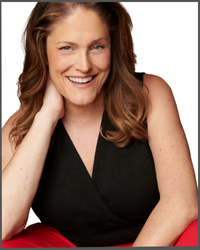
by Sarafina Vecchio ~ Actor, Director, Educator
Sarafina is one of ASC’s primary Core Instructors. Find out more about her here.